
In the Storm Patrol Young Professionals Program, students are introduced to the Storm Patrol characters from the Hawaiʻi Department of Transportation’s popular Elementary School storybook who have grown to become professionals in storm water management.
Throughout the program, these characters showcase different career pathways within storm water management. The program introduces concepts and guides skill-building activities in the environmental professional fields of engineering, architectural design, science, and planning. Students then are invited to take on the role as one of these professionals where they will explore the process of contributing to a storm water management team through guided activities and an optional place-based project.
Introductory lessons provide a framework of information relevant to storm water management, presenting common problems and solutions in the field and directing students to observe their communities to identify opportunities for their team’s potential project.
Subsequent lessons focus on introducing details of each career pathway and how these professions support specific areas within storm water management. Each lesson provides hands-on activities to build skills and guides students in applying their knowledge to a project.
Concluding lessons focus on project management and the student-led project, allowing more hands-on learning by requiring students to apply the knowledge and skills gained from previous lessons. Each session is designed to guide students toward project collaboration, design, management, and, where plausible, implementation.
The Storm Patrol Young Professionals lesson plan guide is designed for maximum flexibility, offering multiple learning and scheduling tracks to suit various educational environments:
-
Integrated Learning Modalities: Combines career-based exploration with three distinct learning tracks to engage students and build leadership skills:
-
Theoretical Place-Based (Mock Site): Uses a hypothetical local campus site for students to practice concepts before applying them elsewhere.
-
Project Based Learning (PBL): An optional track where students apply their skills to solve significant real-world environmental issues in their own communities.
-
Activity-Centric Learning (Afterschool): A highly tactile approach focusing on hands-on skill-building, specifically designed to fit after-school program frameworks.
-
-
Adaptable Course Scheduling:
-
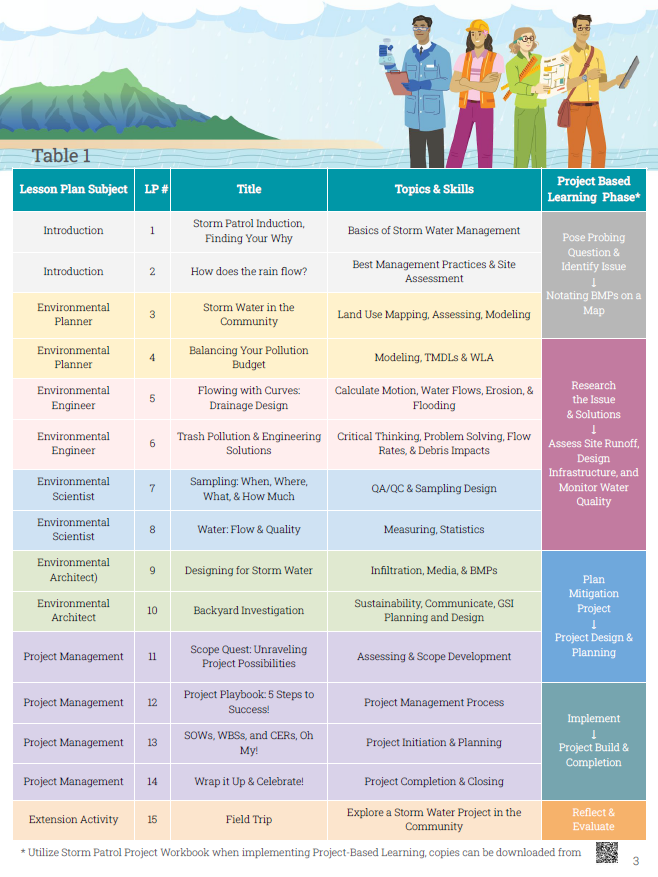
Full Semester Course: The 15 core lessons (including the field trip) provide a full semester of content when meeting once per week.
-
Twice-Weekly Intensive: For programs meeting twice a week, the most ideal structure is conducting a Mock Site theory lesson on the first day, followed by a real-world project application on the second day.
-
Short Career Tracks: Specialized 5-lesson modules (2 intro lessons, 2 career-specific lessons, and 1 project management or field trip) can be completed in a single week with daily meetings.
-
-
Standardized & Customizable Timing: Each lesson is optimized for a 1-2 hour time frame. Every plan includes specific “Tips to Truncate” (prioritizing core concepts) and “Tips to Extend” (adding depth) to ensure the curriculum fits the available schedule.
-
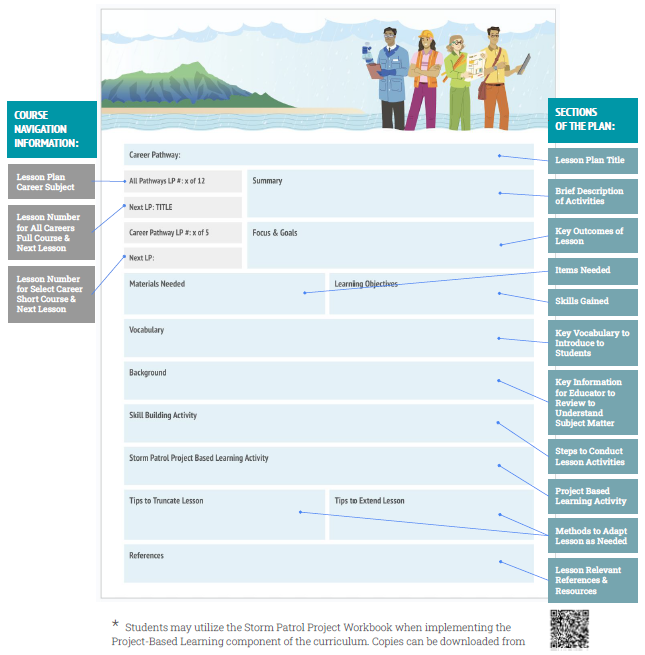
Navigational Templates: Lessons utilize a standard template with dual course length navigation sidebars, indicating lesson numbers for both the all-careers full course and specific career short courses.
-
Comprehensive Project Support: A structured PBL process guides students from problem definition to final synthesis, supported by a student workbook and a detailed overview map of the steps.
-
Educator Resources: Each lesson concludes with supplemental materials, including career exploration tools, community engagement resources, and related PBL frameworks.
LESSON PLAN TEMPLATE
COURSE SCHEDULE
Explore the Hawaii Storm Patrol Young Professional’s Program Lesson Plans & Activities! The lessons are broken down by career type, and include three tracks:
Mock Site Track
Place Based Learning (PBL) Track
Afterschool Track

Are you interested in a free educational program workshop?
HDOT Oʻahu District would like to evaluate interest in an Oʻahu educational program workshop, which would walk participants through the Hawaiʻi Storm Patrol Young Professionals Program’s lessons, concepts, and hand-on activities to prepare them to use the lessons with their students. The workshop would be free to attend and is intended to be a maximum of 6 hours in length. Please complete the following form to let us know whether you would be interested in attending a workshop.
DISCLAIMER
The content provided herein is for informational purposes only and is offered solely as a courtesy. It is not officially endorsed, authorized, or approved by any organization, entity, or individual. Any reproduction, distribution, or use of this content for resale, commercial purposes, or other monetary gain is strictly prohibited and may result in legal action.
Some activities included in this program were inspired and modified from the following:
Project WET (https://www.projectwet.org/)
Project WET (Water Education for Teachers) is a nonprofit organization that provides water education resources for people of all ages, including children, parents, and educators. The program’s goal is to promote awareness, appreciation, knowledge, and stewardship of water resources. Project WET works with partners to create locally appropriate water education curricula for specific countries, cultures, and regions, and is active in approximately 80 countries globally
WQD (https://www.waterboards.ca.gov/water_issues/programs/outreach/)
The California Water Boards developed the Water Quality Detectives After School Program (WQD) specifically for after school programs throughout the state. This program, based on the Water Quality Service Learning Program, uses the same hands-on approach in an outdoor setting to teach students about water quality, and appeals to a wide range of ages for the after school setting.